
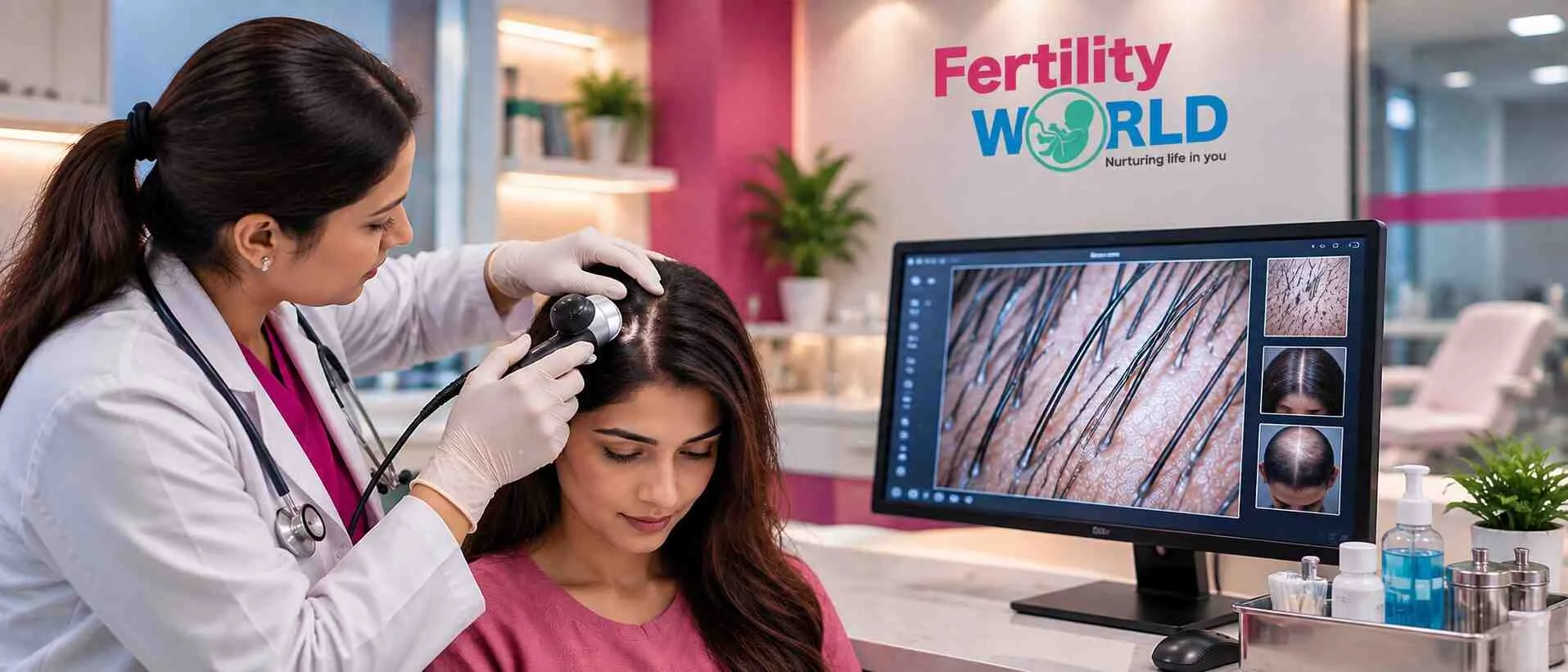
Hair loss is a symptom and not a diagnosis. Hormones, low iron, genetics, or an autoimmune disease might cause thinning that looks the same in the mirror, but each requires a different treatment. That is why the first step is hair loss diagnostics. Hair loss assessment looks at the scalp under magnification, determines the activity of hair shedding and looks at bloodwork for hidden causes.
This page is a full guide to the pathway: which signs are worth acting on, how to examine the scalp, in-office diagnostics, blood panels, when a biopsy is needed and how it all comes together into a clear diagnosis of hair loss. First off, good to know: you don't notice thinning hair until you've lost around half the hair in a region. This section describes standard diagnostic methods for educational purposes only and is not a substitute for a clinical assessment.
What a Hair-Loss Diagnostic Assessment Includes
A full hair loss diagnosis includes four phases: medical history, a clinical scalp and hair examination, in-office testing (including trichoscopy), and specific blood tests. A scalp biopsy is added only if the image remains unclear. Each stage limits the possibilities from the previous one, so nothing is tested without reason:
- Medical history: When did the loss occur, how rapidly, and what was going on in your life 3 months ago
- Scalp and hair analysis: Scalp examined in good light. Hair examined for density, thickness and breakage.
- In-office tests: Quick and painless, this test measures active shedding and magnifies the scalp on screen.
- Blood tests: Ordered selectively to rule out iron, thyroid, nutrient or hormonal causes.
At the end, you get a named cause instead of a guess, along with measurements that have been taken before. You should pay attention to those numbers because hair changes slowly. Knowing where you started lets you measure future growth instead of guessing it. Not everyone who sheds requires a thorough workup, so the first question is whether yours does.
Who Needs a Hair Loss Assessment and When
It is very normal to lose around 100 hairs per day. Counting them will not help. What counts is if your hair is changing in pattern, density or texture over weeks and months. Shedding is an element of the hair cycle. Hair falls from the root, and A new hair grows up in its place.
Hair loss is another story. Either the hair isn't restored, or the shaft breaks mid-length while the root remains fixed. Different causes and different tests for those two cases. And this is the reason people are late too. It takes around half the hair in a region to be lost before your scalp begins to show.
How to Tell if You Are Balding or Thinning
You can see without a mirror trick. Four key observations include much of what you need:
- Your role: Compare it to a picture from a year ago. The first sign is frequently a widening hair part.
- Your hairline: Look at your forehead. Recession there frequently means male pattern loss.
- Scalp: Check it in strong light or take a flash picture. If you're seeing scalp where you didn't before, your density is already down.
- Your ponytail: Thinning overall is a good sign, and a much thinner circumference is a good sign.
What You Notice and What It Usually Means
| What you notice | What it usually points to | Needs assessment? |
|---|---|---|
| Widening part down the middle | Pattern hair loss, more common in women | Yes, if it keeps widening |
| Receding at the temples or hairline | Male pattern hair loss | Yes, early assessment gives more options |
| Hair all over the pillow and drain | Telogen effluvium, a shedding phase | Yes, if it lasts beyond 6 months |
| Round smooth patches of loss | Alopecia areata | Yes, promptly |
| Scalp visible in bright light | Around 50% density already lost | Yes |
| Hair snapping mid-length | Breakage, not root loss | Yes, if styling changes don't help |
| Itching, soreness, redness or scaling | Possible inflammatory or scarring cause | Yes, urgently |
What the assessment is looking for is which of a small number of conditions fits the pattern.
Conditions a Hair Loss Diagnosis Identifies
Each reason leaves its own signature on the scalp. This allows a differential diagnosis of hair loss and is why a professional looks at the pattern before anything else. Most cases are classified into four groups:
- Pattern hair loss: Inherited thinning that occurs gradually in predictable regions.
- Shedding disorders: Telogen effluvium, when hair falls out evenly a few months after a trigger such as delivery, sickness or severe weight reduction.
- Alopecia areata: Sudden, circular bald patches due to an autoimmune disease.
- Scarring alopecia: The inflammation damages the follicle so the loss is irreversible.
Breakage is also caused by chemical and heat treatments and tight styles. It looks like hair loss, but the root is still there, and the treatment is very different. In children, the image narrows rapidly. The two most common causes are tinea capitis and alopecia areata. So, a fungal workup is usually done first.
How Male and Female Pattern Hair Loss Differ on Examination
It begins at the forehead and crown-like structures in men, but the back and sides remain thick. The contrast is a big clue on exam. Women generally keep their frontal hairline. Thinning occurs over the crown, and the portion swells into the shape of a Christmas tree. Women are also in need of bloodwork more often, as thyroid disorders, low iron and elevated androgens can all mimic pattern loss.
Common Causes and Their Diagnostic Clues
| Cause | Typical pattern | What points to it |
|---|---|---|
| Androgenetic alopecia | Widening part, temple recession, vertex thinning | Gradual onset, family history, mixed hair thicknesses |
| Telogen effluvium | Even shedding across the scalp | Follows illness, childbirth, surgery or weight loss by 2–3 months |
| Alopecia areata | Round, smooth bald patches | Sudden onset, distinctive hairs at the patch edge |
| Tinea capitis | Scaly patch with broken hairs | Common in children, itching and scaling |
| Traction alopecia | Loss along the hairline | Tight hairstyles worn over long periods |
| Scarring alopecia | Smooth patches, no visible follicle openings | Burning or soreness, permanent if untreated |
Working out which one applies starts with the two things that need no equipment at all.
Stage One - Medical History and Scalp Examination
Two things do most of the work before any equipment comes out. This is how a dermatologist diagnoses hair loss in most cases: thorough questioning, then a careful examination of the scalp.
The Medical History That Narrows the Diagnosis
Knowing how to diagnose hair loss starts with timing. They'll want to know when it started, how fast it came on and if the hair is coming out from the root or breaking off in the middle. Mention any itching or burning, as it shapes the course of the assessment.
Then the questions multiply to include recent sickness, surgery, childbirth, major weight loss, new medications, your diet, family history and the way you wear your hair. Something from three months ago often explains today's shedding, which is why diagnosing the cause of hair loss means reaching that far back.
What the Clinical Scalp Examination Reveals
The scalp is examined in good light for redness, scaling, pustules, and scars. One element is particularly important: are the follicle openings still visible? They're missing, which suggests scarring alopecia, which is not like the kinds you can get over.
Then the scalp and hair analysis looks at density in various regions, hairline position, how much shaft thickness varies, and whether the hair is breaking. It also covers questions about loss and body hair, narrowing the choices even more. From there, a brief series of in-office tests answers different questions.
Stage Two - In-Office Hair Loss Tests
Each hair loss test here takes a few minutes, doesn’t require a lab, and typically answers the question. The hair pull test determines active shedding. Usually, we take about 50 to 60 hairs and gently pull them along the shaft. If more than five or six come out, there is shedding going on; this suggests telogen effluvium or alopecia areata.
Do not wash hair for 24 hours beforehand, as washing removes loose hairs early and skews the result.
The tug test measures strength, not shedding. If there is fragility or breakage rather than loss from the root, two points of the hair are pulled to see if the shaft breaks in the middle. The card test uses a contrasting felt card against a part. In this context, fresh hairs with tapered tips, blunt broken ends and fine miniaturised hairs are visible and can be counted. A scraping of the scalp under the microscope will answer the same day whether a fungus is detected, and a culture will confirm it over several weeks.
In-Office Tests at a Glance
| Test | What it checks | What a positive result suggests |
|---|---|---|
| Pull test | Active shedding | Telogen effluvium, active alopecia areata |
| Tug test | Shaft strength | Hair shaft disorder, styling breakage |
| Card test | New growth and breakage | Regrowth underway, or shaft abnormality |
| Trichoscopy | Magnified scalp and follicle detail | Distinguishes most alopecia types |
| Scalp scraping / culture | Fungal infection | Tinea capitis (scalp ringworm) |
What Trichoscopy and Digital Scalp Analysis Measure
Trichoscopy magnifies the scalp up to almost 100 times and displays it on screen. It assesses hair count per area and shaft diameter. So instead of saying, 'It appears thinner,' you have numbers you can compare next time you visit.
And it's what separates one state from another. Yellow spots with mixed shaft thickness can indicate androgenetic alopecia. Exclamation-mark hairs and black specks suggest alopecia areata. Corkscrew and comma hairs represent tinea capitis, and absent follicular openings mean scarring alopecia. If the scalp doesn't explain it, it's usually the blood.
Stage Three - Hair Loss Blood Tests
There is no single blood test for hair loss that diagnoses the disorder. Tests are ordered to rule out underlying causes: iron deficiency, thyroid disease, nutrient deficiencies and hormonal imbalance, each of which can drive shedding.
That's also why lab tests for hair loss are specific, and not general. The examination determines whether tests are worth doing, so you aren't sent for a panel that answers questions nobody requested.
Common Hair Loss Lab Tests
| Test | What it measures | Why it's ordered |
|---|---|---|
| Ferritin | Stored iron | Low stores linked with diffuse shedding, common in menstruating women and vegetarians |
| Full blood count | Red cells and haemoglobin | Screens for anaemia |
| TSH, T3, T4 | Thyroid function | Over- and underactive thyroid both affect hair |
| Vitamin D, B12, zinc | Nutrient levels | Deficiencies contribute to shedding |
| Testosterone, DHEAS | Androgen levels | Raised levels in women, alongside acne or irregular periods |
| ANA | Autoimmune markers | Where autoimmune disease is suspected |
And ferritin deserves a remark by itself. It measures iron stores rather than what is in your blood at the time, so levels can be low enough to affect hair while a conventional blood count remains normal.
Hormonal factors usually don't present alone. If you have irregular periods, acne, unsightly facial or body hair, or a sudden weight shift along with thinning, a hair loss hormone test is in order. This is also why labs for hair loss in women are ordered more commonly. A woman with diffuse thinning and no bald patches may have androgen excess, thyroid disease or just low iron, and only tests can distinguish them. So far, in a few situations, the tests still left the question unanswered.
Stage Four - Scalp Biopsy When Certainty Is Needed
Most assessments don’t go this far. If the picture is still unclear, or if more than one reason may be operating at the same time, or if scarring alopecia is suspected, a scalp biopsy for hair loss is done. The procedure is small. A tissue sample is taken under local anaesthetic with a pencil-sized device, usually from the active edge of an afflicted area. This is closed with one or two sutures and done in the clinic.
The sample is then cut in two directions, displaying the follicle at each level, and the ratio of growing to resting hairs. It is still the best approach to confirm scarring alopecia, which is key because these forms are irreversible once the follicle is lost. Each step answers a part of the question. The following is their combination.
How the Findings Become a Diagnosis
There’s not one test that says this is the condition. We read the history, examination, and results together to arrive at a differential diagnosis of hair loss. Take a familiar example. Six months after labour, a lady with generalised thinning and a positive pull test seems like uncomplicated telogen effluvium.
Add a low ferritin test and varying shaft thickness on trichoscopy, and you may have two causes at the same time. That overlap is common, which is why careful assessment doesn't end with the first reasonable response. Normal blood results don’t always mean nothing is wrong. For some conditions, labs are entirely normal:
- Early pattern loss: Evidence on trichoscopy much ahead of any changes in blood markers.
- Shedding from a previous trigger: The illness/stress is over, but the hair cycle is still catching up.
- Traction alopecia: caused by stress on the hair, not by the bloodstream.
In those circumstances, the diagnosis is made by inspection, trichoscopy measurements and repeating those measurements over a few months. Once you know the name of the cause, the path ahead is clear. Some types resolve on their own, some respond well to hair loss treatment, while scarring forms require prompt action to protect the remaining follicles. How long does all this take? People really want to know this last thing.
Your Assessment Timeline and How to Prepare for hair loss consultation
Should I see a dermatologist for hair loss? A dermatologist is a professional educated to deal with hair and scalp diseases, so if your loss is unexplained or getting worse, they’re the right place to start. Preparing for your hair loss consultation is easy. Don’t wash your hair 24 hours before, as a pull test needs loose hairs to stay in place. Please bring a record of your medicines and any recent blood results. Remove extensions and clips.
Most participants complete the exam and in-office tests during one visit. The bedside tests are painless, and if a biopsy is needed, this is done under local anaesthetic with slight soreness for a day or two. Standardised photos are frequently taken at the first visit, from multiple angles, so any later comparison is measured rather than guessed at.
Typical Assessment Timeline
| Stage | When it happens | What it involves |
|---|---|---|
| History and examination | First visit | Questions, scalp inspection, photographs |
| In-office tests | Same visit | Pull, tug and card tests, trichoscopy |
| Blood tests | Same visit, results in days | Ferritin, thyroid, hormones as indicated |
| Fungal culture | If suspected | Scraping same day, culture takes weeks |
| Scalp biopsy | If needed | Minor in-clinic procedure, results in 1–2 weeks |
| Diagnosis and plan | Follow-up | All findings reviewed together |
Conclusion
By the time thinning is evident in the mirror, a fair bit of density is gone already. That's the strongest argument for not waiting. The proper hair loss diagnosis is threefold: the pattern of your scalp, your history, and what your bloodwork says. No single hair loss test does this alone, which is why the examination happens in stages.
Timing is very important with scarring types of hair loss, as when follicles are destroyed, they are lost forever. The sooner you act, the more options you have. Hair loss can feel like it's happening to you. Hair loss diagnostics give a name, a reason and a clear direction.
What people ask us before starting
What blood test shows the cause of hair loss?
One test can’t do that. A panel will often look at ferritin, thyroid function, vitamin D, B12 and zinc levels and perhaps androgen levels if a hormonal cause is suspected. They rule causes in or out together.
Is a hair pull test accurate?
It is a reliable way to tell if shedding is occurring at present, but not why. Washing your hair within 24 hours before can cause a false negative result.
How can a specialist tell if hair loss is permanent?
Looking at the scalp to see if openings for follicles are still there. When they are gone the follicle is destroyed and the loss is permanent. If there is question, a biopsy will confirm it.
Can hair loss be diagnosed without a scalp biopsy?
Usually. Yes. Most diagnosis are made based on history, examination, trichoscopy and blood testing. Biopsy is done only in equivocal situations with probable scarring alopecia.
How long does a full hair loss workup take?
The exam and in-office tests are done in one visit. Blood results take a few days, fungal culture several weeks, biopsy one to two weeks.
Do I need to stop any treatments before the assessment?
Avoid washing your hair for 24 hours and skip serums, oils and dry shampoo on the day, as these obscure the scalp during trichoscopy. Mention any vitamins or topical treatments you're using.
Is trichoscopy painful or invasive?
Not at all. A handheld device is rested against the scalp to magnify it on screen. Nothing is removed, nothing is injected, and it takes a few minutes.
Can hair loss be diagnosed from photographs alone?
No. Photos show the pattern, which is informative but they can't assess shedding, shaft diameter or follicle openings. To make a correct diagnosis a physical examination is required.
Why do I need blood tests if my hair loss looks hereditary?
Because two causes often run together. Low iron or thyroid problems can accelerate inherited thinning, and treating only the hereditary part leaves the other one active.
What happens if the cause still isn't clear?
The assessment continues rather than stopping. Repeat trichoscopy measurements a few months apart show whether density is stable or falling, which often reveals the answer time alone can give.