
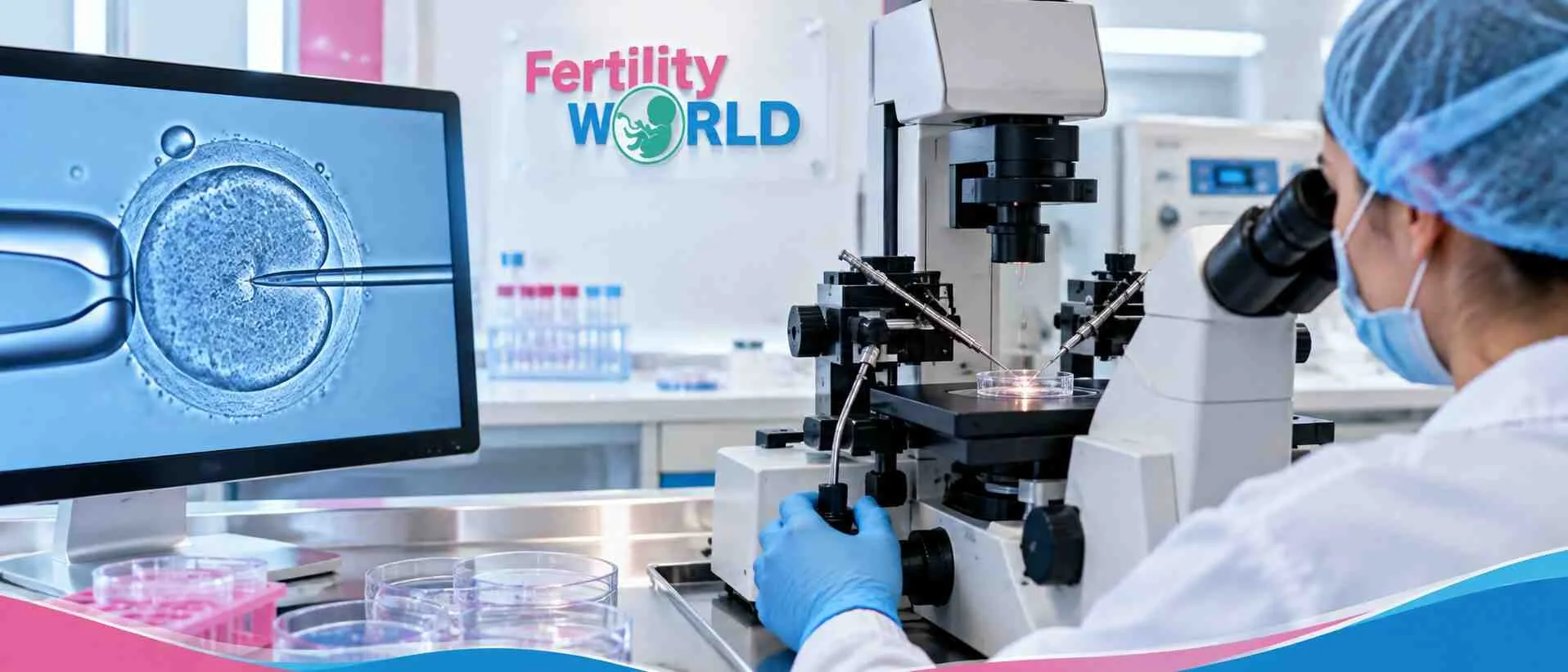
Your semen report came back with numbers you did not expect. Or your last IVF cycle ended with eggs collected, yet few or none fertilised. In both cases, the sperm could not reach or enter the egg on its own, and that is exactly where conventional ICSI (intracytoplasmic sperm injection) steps in.
There is plan conventional ICSI treatment around your reports, your history and your next cycle. On this page, you will see who needs it, how the ICSI procedure works step by step, how long it takes, what shapes success and cost, and how it differs from standard IVF. Sometimes a cycle doesn't need millions of sperm. It needs just one, placed with care.
How Conventional ICSI Works
In natural conception, many sperm travel to the egg, but only one breaks through its outer layers. For some couples, that journey is too hard. Conventional ICSI removes this barrier by placing one healthy sperm inside one mature egg, so ICSI fertilisation no longer depends on how well sperm can swim or enter.
Is every egg suitable for injection? No. Only mature eggs can be injected, as immature eggs are not ready for fertilisation. So fewer eggs may be injected than collected.
Why ICSI Is Used During IVF
ICSI is used during IVF when leaving sperm to fertilise the egg is unlikely to work. This ICSI IVF treatment, often called IVF with ICSI, keeps the cycle the same. Egg retrieval, embryo growth and transfer happen as usual. Only the fertilisation step changes. In conventional ICSI, the embryologist handles that step. For the wider picture, see our ICSI treatment page. Next, let us look at who benefits most from this conventional ICSI fertilisation technique.
Who Needs Conventional ICSI Treatment
Not every couple needs ICSI for male infertility, but for many it offers a real chance at pregnancy. Doctors usually advise ICSI treatment for male infertility when male factor infertility, such as a low sperm count or poor sperm movement, makes it hard for sperm to reach or enter the egg on their own.
Is ICSI needed if only a few sperm are found on testing? In many cases, yes. Even when a semen test finds just a handful of live sperm, the embryologist can still use them for injection, so a very low result does not have to end your hopes.
| Your Situation | How We Help |
|---|---|
| Low sperm count | We plan conventional ICSI so each mature egg needs only one healthy sperm |
| Poor sperm motility | We choose ICSI, so sperm does not have to swim to the egg |
| Abnormal sperm morphology | We recommend conventional ICSI so the best-formed sperm is selected |
| Retrieved or frozen sperm | We match ICSI to the small number of sperm available after TESA, PESA or freezing |
| Previous fertilisation failure | We advise ICSI when sperm could not enter the egg in an earlier cycle |
ICSI treatment with retrieved sperm is also common after TESA or PESA, and it can be done with sperm saved earlier through sperm freezing.
Can ICSI Help With Low Sperm Count or Poor Motility?
Yes, in many cases. When the numbers are only slightly low, IUI or standard IVF may still work well. But when only a few million moving sperm remain after washing, or motility is very poor, fertilisation in the dish becomes unlikely. This is where ICSI treatment for low sperm count and poor sperm motility helps most, and why conventional ICSI for male infertility is often the better choice.
Is ICSI Recommended After Failed Fertilisation?
Yes, in most cases. Sometimes eggs are collected, yet few or none fertilise because sperm cannot enter them. Although this result is painful, it gives your doctor a clear answer, and ICSI usually becomes the next step after fertilisation failure. Before planning it, a few simple tests help us decide.
What Tests Are Needed Before Conventional ICSI Treatment?
A few simple tests before ICSI treatment help us understand what each partner needs. Do both partners need tests before ICSI? Yes. Sperm results show whether ICSI is needed, while the female partner's results shape how we plan the cycle.
- Semen analysis: Your semen analysis results show sperm count and sperm motility, measured against WHO reference values.
- Egg reserve tests: An antral follicle scan and an AMH blood test can tell you how many eggs you can get. This helps us plan the right stimulation for you.
- Hormone tests: These check hormones that control how eggs grow and how sperm are made so that we can treat any problems first.
- Infection screening: Both parents must be checked for diseases like HIV and hepatitis before they can start IVF.
Which Semen Analysis Results Point Towards ICSI?
ICSI is usually advised when results fall well below WHO reference values. As a guide, WHO lists 16 million sperm per millilitre as the lower limit for sperm count and 30% for forward-moving sperm. Results close to these limits may still suit IUI or standard IVF. But when the count drops far lower, or very few sperm move forward, conventional ICSI gives fertilisation a much better chance.
What Are the Steps of the Conventional ICSI Procedure?
The ICSI procedure, also called the intracytoplasmic sperm injection procedure, follows a normal IVF cycle with one careful change at fertilisation. Here is the ICSI procedure step by step.
| Stage | What Happens |
|---|---|
| Ovarian stimulation | Eggs grow under daily medication and scan monitoring |
| Egg retrieval | Eggs are collected under sedation in a short procedure |
| Sperm preparation | The sample is washed and prepared in the IVF laboratory |
| Egg maturity check | The embryologist sorts mature eggs from immature ones |
| Sperm injection | One selected sperm is injected into each mature egg |
| Fertilization check | Fertilised eggs are identified the next day |
| Embryo culture | Embryos grow to day 3 or day 5 |
| Embryo transfer or freezing | The best embryo is transferred or frozen for later |
Is the ICSI procedure painful for the woman? Not usually. Egg retrieval is done under sedation, so you rest through it. Mild cramping afterwards often settles within a day or two, and the ICSI step itself happens in the lab. After fertilisation, we closely monitor your embryos and plan the transfer for the healthiest one.
Which Sperm Is Chosen for ICSI?
Before choosing one, the embryologist examines each sperm closely. Normal sperm morphology, which means that the head and tail are well formed, and steady forward movement are the two most important things.
This careful selection ensures each mature egg gets the healthiest sperm possible, even if it's only a small amount.
How Is Sperm Injected Into the Egg During ICSI?
Conventional ICSI uses standard microinjection with a very fine glass needle. First, the embryologist removes the outer cells around each egg to confirm it is mature. A holding pipette then holds the egg steady.
The embryologist slows the chosen sperm, draws it into the needle, and places it inside the egg. This oocyte injection takes only minutes. After the sperm injection, the eggs rest overnight before staff check for fertilisation. Next comes the treatment timeline.
Duration of Conventional ICSI Treatment: How long does ICSI treatment take?
For most couples, one fresh conventional ICSI cycle takes about four to six weeks, from the first stimulation injection to the pregnancy test.
- Ovarian stimulation (10 to 12 days): You take daily injections, with regular scans to track how your eggs are growing.
- Egg retrieval and ICSI (1 day): Eggs are collected about 36 hours after the trigger shot, and ICSI is done the same day. Embryo growth (3 to 5 days): Your embryos grow in the lab while the embryologist checks their progress.
- Fresh transfer: The best embryo is transferred straight away, often as a day-5 [blastocyst transfer].
- Frozen transfer (a later month): Embryos are stored and transferred once your uterine lining is ready. This adds a few weeks but gives your body time to rest.
- Pregnancy test (about 2 weeks later): A blood test after transfer confirms whether the cycle has worked.
Now that you know how long each stage takes, it helps to see how conventional ICSI differs from standard IVF, and why that difference matters for your treatment plan.
Is ICSI Better Than Conventional IVF?
Not always, because it depends on the sperm. The main difference between conventional IVF and ICSI is how the sperm meets the egg. In standard IVF, many sperm are placed around each egg, and one must enter on its own. With ICSI, the embryologist places a single sperm inside the egg.
So when you compare ICSI vs conventional IVF, conventional insemination vs ICSI or conventional fertilisation vs ICSI, the real question is whether sperm can do that work alone.
| Factor | Conventional IVF | Conventional ICSI |
|---|---|---|
| How sperm meets egg | Sperm placed around the egg | One sperm injected into the egg |
| Sperm needed | Many motile sperm | One healthy sperm per egg |
| Fertilization control | Left to the sperm | Guided by the embryologist |
| Lab technique | Insemination | Micromanipulation |
| Sperm handling | Sperm concentrated and added in bulk | Each sperm chosen and immobilised individually |
Both methods use the same IVF cycle, so choosing conventional IVF or ICSI does not change your stimulation, retrieval or transfer. Can conventional IVF and ICSI be used in the same cycle? Yes. In a split approach, some eggs are fertilised with standard IVF and the rest with ICSI. It helps when results are borderline.
Does Piezo ICSI Work Better Than Conventional ICSI?
Not for everyone. Piezo ICSI uses tiny vibrations, instead of a direct push, to open the egg's membrane. This may put less stress on fragile eggs. For most patients, conventional ICSI remains the standard method used in IVF laboratories. Next, let us look at what shapes the cost of treatment.
Conventional ICSI Success Rate: What Affects Your Chances?
ICSI numbers can feel confusing because two different rates are often quoted. The fertilisation rate shows how many injected eggs fertilise, usually around 70 to 80 per cent. The pregnancy rate shows how many cycles lead to pregnancy, and it depends mostly on age.
So when you see an ICSI treatment success rate, check which one it describes.
| Age Group | Approximate Pregnancy Chance per Cycle |
|---|---|
| Under 35 | Around 40 to 50% |
| 35 to 37 | Around 30 to 40% |
| 38 to 40 | Around 20 to 30% |
| 41 to 42 | Around 10 to 15% |
| Over 42 | Below 5% |
Does ICSI guarantee pregnancy? Sadly, no treatment can. ICSI helps sperm enter the egg, but it cannot make every embryo healthy. It gives you a fair, real chance.
So, what factors affect ICSI success? Beyond age, the main ones are:
- Egg quality: Mature, healthy eggs form stronger embryos.
- Sperm DNA quality: High DNA damage can lower embryo quality.
- Embryo quality: Embryos that reach the blastocyst stage implant more easily.
- Uterine health: A healthy lining helps the embryo settle.
Are There Any Risks With ICSI Treatment?
The good news is that the risks are small, and your doctor explains each one first. A few eggs may be damaged during injection. If male infertility has a genetic cause, it can pass to a son, so genetic counselling may be advised. ICSI also shares the usual IVF risks, such as ovarian hyperstimulation or multiple pregnancy.
Why Choose Conventional ICSI
Choosing ICSI fertility treatment is a big step, and you should not face it alone. The clinic will stay with you from your first report to your final result. Who plans the ICSI part of an IVF cycle? Your fertility specialist decides on ICSI, and the embryologist performs it. We keep both working from one plan, built around you.
| Service Stage | How We Support You |
|---|---|
| Report review | Read your semen and IVF reports first |
| Suitability | Confirm whether conventional ICSI suits you |
| Cycle planning | Map each date with you |
| Lab coordination | Make sure ICSI is in your lab plan |
| Results | Explain your fertilization and embryo reports |
| Follow-up | Stay with you beyond the pregnancy test |
Whether this is your first ICSI infertility treatment or a second attempt, we keep every step clear. Sometimes, one healthy sperm and the right support can be enough.
What people ask us before starting
What is conventional ICSI?
Conventional ICSI is an IVF lab method where one healthy sperm is injected directly into each mature egg. It helps fertilization happen when sperm cannot reach or enter the egg on its own.
Does conventional ICSI need a hospital stay?
No, you do not need to stay overnight. Egg retrieval is a short day procedure under sedation, and most women go home the same day after a little rest
Can ICSI be done with donor sperm?
Yes, ICSI can be done with donor sperm. It is usually chosen when the frozen donor sample is limited or when egg-related factors make standard IVF less likely to work.
Does ICSI increase the chance of twins?
ICSI itself does not raise the chance of twins. The number of embryos transferred does, which is why a single embryo transfer is often advised for a safer pregnancy.
Can conventional ICSI be combined with genetic testing of embryos?
Yes, and ICSI is often preferred when embryos are tested, as it keeps extra sperm away from the sample. Your embryos can then be checked through [embryo biopsy] before transfer.
How many ICSI cycles might you need?
Many couples conceive within one to three cycles, though this depends on age, egg quality and sperm health. Your doctor will review each cycle's results before planning the next.
Can ICSI be done with donor eggs?
Yes, ICSI works well with donor eggs. It is often used when the partner's sperm needs help, so each donor egg has the best chance of fertilizing.
Do you need to abstain before giving a sperm sample for ICSI?
Yes, a short break of two to five days is usually advised before giving the sample. This helps collect sperm with a better count and movement on the day.
Can you continue normal work during ICSI treatment?
Yes, most people carry on working through the cycle. You may only need a day off for egg retrieval, and light activity is fine after embryo transfer.
Is sex selection possible with ICSI?
No. Fertility World does not support or disclose fetal sex determination or sex selection in any form, in line with the PCPNDT Act 1994.