
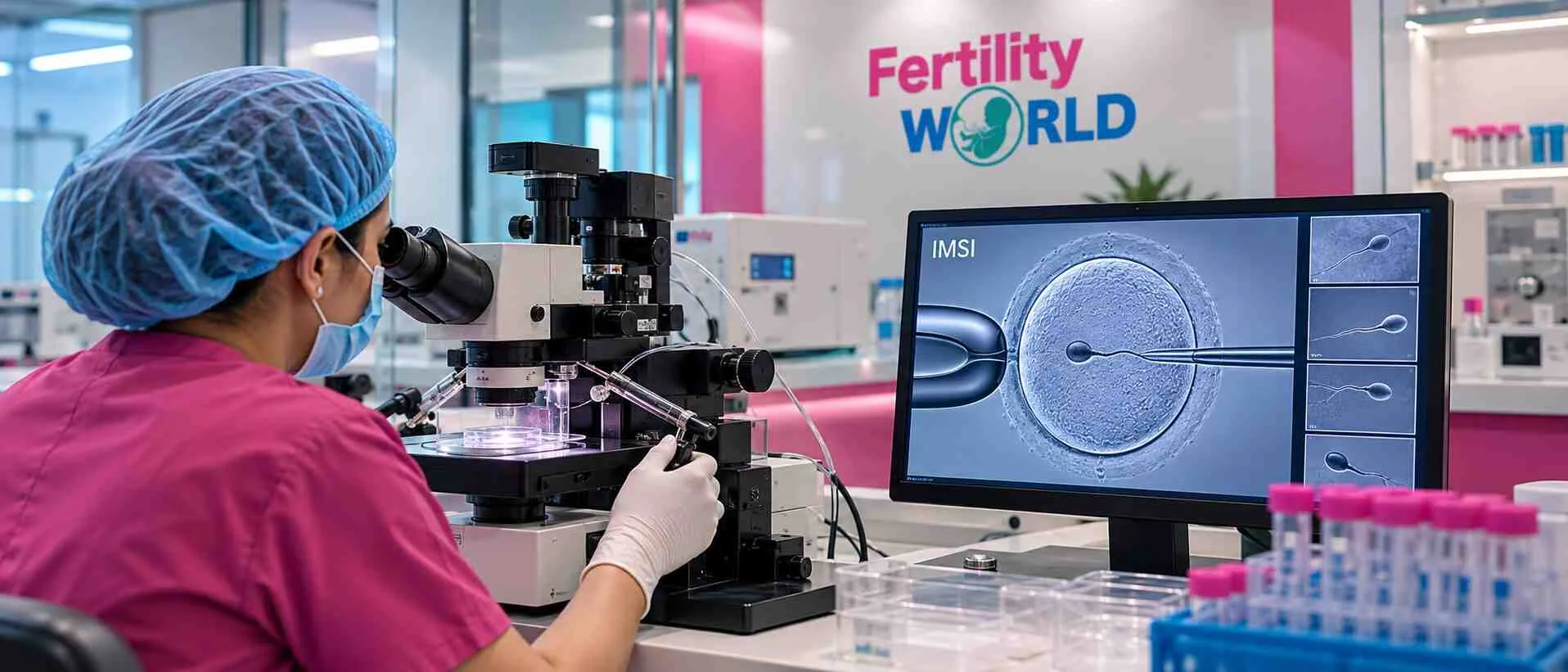
One question remains after a failed ICSI cycle: what went wrong? Sometimes the explanation is in the semen report, where morphology results show just a small percentage of normally shaped sperm. This is exactly the situation for which intracytoplasmic morphologically chosen sperm injection (IMSI) was developed. It is a sperm selection process for IVF that looks at sperm under very high magnification, so the embryologist can pick the best-looking one before putting it into the egg.
In this section, we describe how IMSI works, how it compares with standard ICSI, who can benefit from it, what the research shows, what alternatives are available, and what it costs. Here's what most couples are surprised to learn: At the magnification used in a normal cycle, an embryologist only sees a portion of what is actually in a sperm head.
What Is IMSI (Intracytoplasmic Morphologically Selected Sperm Injection)?
IMSI is an advanced laboratory technology used in IVF with ICSI, allowing the embryologist to look at sperm at more than 6,000x magnification to select the most structurally healthy sperm before injecting it into the egg. The full name, intracytoplasmic morphologically selected sperm injection, sounds complex, but the idea is simple: look closer before choosing. IMSI in IVF is a step in an ICSI cycle, not a treatment on its own.
Why Sperm Morphology Matters in IVF and ICSI
Morphology is the study of form, of structure. A good sperm has a single, straight tail, a compact midpiece and an oval head with a smooth surface. Shape matters – it’s often a reflection of what’s inside. Sperm with abnormal heads are more likely to have damaged DNA that might affect embryo development. Standard ICSI looks at sperm at 200- 400x, enough to see obvious flaws but not the finer detail inside the head.
The Role of MSOME in High Magnification Sperm Selection
The high-magnification sperm selection is based on MSOME, the imaging technique that allows IMSI. It magnifies living sperm more than 6,000 times, so the embryologist may see:
- Head shape: If the outline is smooth and even.
- Vacuoles: Little pockets of nothing in the skull, like air bubbles. The big ones are connected to DNA damage; therefore, those sperm are put away.
- Midpiece and tail: No defects seen at reduced magnification.
Knowing what the embryologist is hunting for makes the procedure itself easy to follow.
How Does IMSI Work? The Procedure Step by Step
An IMSI process is much like IVF with ICSI to you. You have the same medications, the same scans, the same egg collection. The extra work goes on silently in the lab on the day your eggs are retrieved. And this is how the full cycle is fitted.
| Stage | Where it happens | What happens |
|---|---|---|
| Ovarian stimulation | Clinic visits | Injections and scans to grow multiple eggs |
| Egg retrieval | Day procedure, under sedation | Mature eggs collected |
| Semen sample | Same day | Sample given and prepared in the lab |
| MSOME screening | Lab, 6,000x+ | Sperm examined for vacuoles and head defects |
| Sperm selection | Lab | Sperm with the cleanest structure chosen |
| Injection (ICSI step) | Lab | One selected sperm injected into each egg |
| Embryo culture | Lab, 3–5 days | Fertilisation checked, embryos grown to blastocyst |
| Embryo transfer | Clinic | Best embryo transferred, or all frozen |
What Embryologists Look For Under the Microscope
The IMSI sperm selection is based on the ranking of sperm according to the form of the head and the size and quantity of vacuoles, sometimes using scoring methods such as the Cassuto-Barak criterion. Not all labs provide this level of selection for ICSI, as it takes hours to review thousands of sperm in this way and it requires specific training.
How Long Does an IMSI Cycle Take? This is a typical schedule for an IVF cycle: about 4-6 weeks from your first shot to embryo transfer. The only difference is the length of the lab day, because IMSI fertilisation has to wait for that rigorous screening. You do not need to do anything else. As IMSI is within an ICSI cycle, the obvious issue is what benefit the extra amplification provides.
IMSI vs ICSI: What Is the Difference?
Both methods use the same small needle and the same equipment to deliver a single sperm straight into an egg. No modifications are made to the injection. The difference is what happens before that. ICSI treatment selects the sperm in minutes at moderate magnification, but IMSI examines it in much greater detail, which takes much longer.
IMSI vs Conventional ICSI
| Feature | Conventional ICSI | IMSI |
|---|---|---|
| Magnification | 200–400x | Over 6,000x |
| What can be seen | Overall shape and obvious defects | Fine head structure and vacuoles |
| Selection time | Minutes | Considerably longer |
| Injection method | Identical | Identical |
| Extra cost | None | Yes, an add-on fee |
| Typical use | Standard for male factor infertility | Selected cases only |
Benefits of IMSI Over Conventional ICSI
All of the benefits of IMSI depend on what the embryologist can see and achieve at the stage of selection:
- Finer detail: You can see the inside anatomy of the head, not just the shape.
- Better exclusion: You can exclude large vacuoles in sperm.
- Live assessment: Sperm are evaluated as alive, without any staining or dye.
- A preservation option: You can preserve and view the sperm of choice.
These are true technical breakthroughs in advanced sperm selection. Whether they lead to more pregnancies is another topic, and we examine the evidence honestly lower down this page. Those benefits are mainly applicable to a specific group of patients. Let's see who they are.
Who Needs IMSI Treatment?
IMSI is not part of the normal IVF procedure and will not be needed for most couples going through ICSI. It is only taken into account where there is a definite indication that the structure of the sperm is the limiting factor. Most of the time, that logic can be found in one of two places:
- Your semen analysis: especially the morphological outcome, and any DNA fragmentation tests.
- Your cycle history: What happened to the embryos in past IVF or ICSI attempts.
IMSI for Poor Sperm Quality and Abnormal Morphology
Teratozoospermia is the presence of a large percentage of abnormally shaped sperm. When the morphology findings are very low, it is difficult to locate a well-formed sperm at conventional magnification. The most frequent suggestion in these situations, especially if the sperm DNA fragmentation is considerable, is IMSI for poor sperm quality.
Considering IMSI After Failed IVF or ICSI Cycles
Couples typically ask about IMSI after failed ICSI, if embryos consistently fail to grow or implant. It’s a good question, and one aspect of the problem is sperm quality. But sperm is only part of the story. “Egg quality and age still play the biggest role in the outcome, so a complete assessment of both partners always comes first.”
| Situation | Why sperm structure may be the issue |
|---|---|
| Severe teratozoospermia | Most sperm are abnormally shaped |
| High DNA fragmentation | Damaged sperm DNA affects embryo development |
| Repeated ICSI failure | Standard selection hasn't produced a pregnancy |
| Embryos arresting early | Poor development may trace back to sperm quality |
| Recurrent miscarriage | Sperm DNA is one of several possible factors |
| Unexplained infertility | Considered only after other causes are ruled out |
Not sure if IMSI applies to you? Fitting the profile is one thing. The next question is: what does the research truly say?
IMSI Success Rate, Evidence and Safety
There's no single IMSI success rate we can quote you. Outcomes depend much more on the woman's age, egg quality, and lab quality than on how the sperm was selected. This is what the study says:
- Early studies (2000s): few studies showed that the chance of getting pregnant went up after ICSI rounds failed. This is why IMSI started being offered in all clinics.
- Later research: Larger, better-designed studies haven't shown this to be true. In one study of 216 couples who had failed two ICSI cycles, live birth rates were 20% with IMSI and 19% with normal ICSI.
- The regulator's view: The UK's HFEA gives IMSI a grey rating, meaning there isn't enough high-quality data to claim it improves your chances of having a baby.
Safety is easier. Your body is not exposed to any other things, so the risk of IMSI is the same as a normal IVF with an ICSI cycle, with no extra risk to the baby. One honest point – some research has shown slightly reduced fertilisation rates, probably because eggs and sperm are outside the incubator longer.
Does IMSI Improve Embryo Quality?
Mostly no, studies found no real difference in early embryo grades. A few showed better growth to blastocyst stage, but the results don't agree, so be careful with big IMSI embryo quality claims. Is IMSI Worth It for Your Situation? It's a choice, not a promise.
IMSI is useful when your testing indicates that sperm shape is the real problem and not something you use as an upgrade on every cycle. Your specialist can review your reports and tell you honestly whether it would change anything for you. IMSI is not the only approach to improve sperm quality, so it's important to learn the alternatives.
Alternatives to IMSI for Advanced Sperm Selection
IMSI is not the only one. There are a number of sperm selection techniques, and each technique selects sperm differently. Your embryologist will select the one that best suits your semen analysis. Here is how the main alternatives work:
- PICSI: Sperm are exposed to a droplet of hyaluronic acid (the same material that envelopes a real egg). Mature sperm attach to it, and they are the ones chosen.
- Microfluidic sorting (Zymōt-type chips): Sperm swim through a narrow channel, and only the strongest swimmers (those with less DNA damage) make it to the other side.
- MACS: Small magnetic beads attach to sperm that are starting to die and remove these sperm from the sample.
Sperm Selection Methods Compared
| Method | How sperm are chosen | Best considered for |
|---|---|---|
| Conventional ICSI | Visual check at 200–400x | Standard male factor infertility |
| IMSI | Structure examined at 6,000x+ | Severe abnormal morphology, repeated failure |
| PICSI | Binding to hyaluronic acid | Sperm maturity concerns, miscarriage history |
| Microfluidic sorting | Motility through a micro-channel | High DNA fragmentation |
| MACS | Magnetic removal of dying sperm | High DNA fragmentation |
To be honest, like IMSI sperm selection, none of these procedures has significant evidence of higher live birth rates. The appropriate decision depends on your diagnosis, not which technique sounds the most advanced. Once you and your professional have agreed upon the procedure, the practical question is cost.
How Much Does IMSI Treatment Cost?
IMSI is not a replacement, but an addition. You pay for a full IVF with ICSI cycle and the IMSI cost is an extra on top of that. That extra charge isn’t random. This includes a high-powered microscope with digital images used especially for IMSI and the hours an embryologist spends looking at thousands of sperm, one by one. IMSI is not done by every embryologist; thus, labs train them specifically. In India, IMSI typically adds about ₹20,000–₹40,000 to the cost of an IVF-ICSI cycle. It depends on the clinic and how much lab time your sample takes.
What Your IMSI Treatment Fee Covers
| Cost component | What it includes |
|---|---|
| IVF with ICSI cycle | Stimulation, retrieval, injection, culture and transfer |
| IMSI add-on | MSOME screening and high-magnification sperm selection |
| Semen analysis and DNA fragmentation test | The tests that decide whether IMSI is advised |
| Embryo freezing (optional) | Vitrification and the first year of storage |
Before you make your move, it helps to know what moves the total. Genetic testing or extra storage will add to your bill, and medication doses vary from person to person. Ask for everything in writing so you’re not caught out by any surprises further down the line.
We believe IMSI has a position to play when your tests indicate sperm shape as the real issue. In that case, the extra oversight targets something specific, not a generic update to your cycle. If your findings don’t point that way, we’ll tell you, and your money stays with the treatment that will genuinely benefit you. And that takes us back to the most important thing: the team making the call.
Conclusion
IMSI allows embryologists a far closer look before injecting. And for some couples, that extra care is worth it. This matters most if tests show highly abnormal morphology, excessive DNA fragmentation, or frequent ICSI cycle failures. The starting point is not the procedure itself, but a semen analysis and an honest appraisal of your past cycles. The next right step is the one you choose with clear knowledge, not the one with the longest name.
What people ask us before starting
What is the difference between IMSI and ICSI?
Both use the same technique to deliver a single sperm into an egg. Selection is the difference. ICSI is looking at the sperm at 200-400x. IMSI is looking at the sperm at over 6,000x, looking at the fine structure of the head, and then making a selection.
Can I have IMSI if I'm already having ICSI?
Yes. IMSI is an additional stage in an ICSI cycle, not a separate treatment. It is used for the sperm selection stage and nothing else is changed to your cycle or your medicine.
Does my sperm sample need to be fresh for IMSI?
Living sperm are evaluated in real time, therefore a fresh sample is the norm on egg collection day. Sometimes frozen or medically extracted sperm can be utilized. Discuss this in advance.
IMSI vs ICSI: which is better for my case?
Neither is universally better. IMSI is considered when tests point to sperm structure as the problem, such as severe abnormal morphology or repeated ICSI failure. For most couples, standard ICSI is enough.
Will IMSI help if egg quality is the main issue?
No. IMSI just enhances sperm selection. If the issue is egg quality or age, your specialist will focus on that instead, because sperm selection can't help with that.
What is the success rate of IMSI?
No figure whatever. Larger studies have not shown a clear improvement in live birth rates compared with normal ICSI and the evidence is rated as insufficient by the UK’s HFEA. Age and egg quality are the main determinants of outcome.
Is IMSI safe for me and the baby?
Yes. Nothing is done additional to your body therefore the risks are the same as every ICSI cycle. Research thus far has found no extra risk to kids born after IMSI has been identified.
How long does the IMSI procedure take in the lab?
Screening thousands of sperm adds several hours to the lab day. Your cycle length doesn't change, though, and the extra time requires nothing further from you.
Can IMSI reduce the risk of miscarriage?
Some of the early work suggested this but later work hasn't proved it. Only one of several potential causes of recurrent miscarriage is the quality of sperm DNA and a comprehensive work up is needed initially.
What are the alternatives to IMSI for poor sperm quality?
PICSI, microfluidic sorting, and MACS all choose sperm differently. None offers good proof for superior live birth rates therefore it is up to your semen analysis and diagnostic to choose.